Showing posts with label anthropomorphic. Show all posts

Wednesday, July 14, 2010

Fables of La Fontaine, Dancing Goats and Fighting Roosters


Philomel And Progne 


From home and city spires, one day,
The swallow Progne flew away,
And sought the bosky dell
Where sang poor Philomel.
"My sister," Progne said, "how do you do?
It's now a thousand years since you
Have been concealed from human view;
I'm sure I have not seen your face
Once since the times of Thrace.
Pray, will you never quit this dull retreat?"
"Where could I find," said Philomel, "so sweet?"
"What! sweet?" cried Progne sweet to waste
Such tones on beasts devoid of taste,
Or on some rustic, at the most!
Should you by deserts be engrossed?
Come, be the city's pride and boast.
Besides, the woods remind of harms
That Tereus in them did your charms."
"Alas!" replied the bird of song,
"The thought of that so cruel wrong
Makes me, from age to age,
Prefer this hermitage;
For nothing like the sight of men
Can call up what I suffered then."
Book 3, Fable 15 


THE TWO BULLS AND THE FROG


Two bulls engaged in shocking battle,
Both for a certain heifer's sake,
And lordship over certain cattle,
A frog began to groan and quake.
'But what is this to you?'
Inquired another of the croaking crew.
'Why, sister, don't you see,
The end of this will be,
That one of these big brutes will yield,
And then be exiled from the field?
No more permitted on the grass to feed,
He'll forage through our marsh, on rush and reed;
And while he eats or chews the cud,
Will trample on us in the mud.
Alas! to think how frogs must suffer
By means of this proud lady heifer!'
This fear was not without good sense.
One bull was beat, and much to their expense;
For, quick retreating to their reedy bower,
He trod on twenty of them in an hour.

Of little folks it oft has been the fate
To suffer for the follies of the great.


The Two Goats

Since goats have browsed, by freedom fired,
To follow fortune they've aspired.
To pasturage they're wont to roam
Where men are least disposed to come.
If any pathless place there be,
Or cliff, or pendent precipice,
It's there they cut their capers free:
There's nothing can stop these dames, I wis.
Two goats, thus self emancipated,
The white that on their feet they wore
Looked back to noble blood of yore,
Once quit the lowly meadows, sated,
And sought the hills, as it would seem:
In search of luck, by luck they me
Each other at a mountain stream.
As bridge a narrow plank was set,
On which, if truth must be confessed,
Two weasels scarce could go abreast.
And then the torrent, foaming white,
As down it tumbled from the height,
Might well those Amazons affright.
But maugre such a fearful rapid,
Both took the bridge, the goats intrepid!
I seem to see our Louis Grand
And Philip 4. advance
To the Isle of Conference,
That lies "between Spain and France,
Each sturdy for his glorious land.
Thus each of our adventurers goes,
Till foot to foot, and nose to nose,
Somewhere about the midst they meet,
And neither will an inch retreat.
For why? they both enjoyed the glory
Of ancestors in ancient story.
The one, a goat of peerless rank,
Which, browsing on Sicilian bank,
The Cyclop gave to Galataea;
The other famous Amalthaea,
The goat that suckled Jupiter,
As some historians aver.
For want of giving back, in troth,
A common fall involved them both.
A common accident, no doubt,
On Fortune's changeful route.
Jean de La Fontaine
Book 12, Fable 4 


The two roosters

Two roosters in peace were living, when
A war was kindled by a hen.
O love, you bane of Troy! It was thine
The blood of men and gods to shed
Enough to turn the Xanthus red
As old Port wine!
And long the battle doubtful stood:
(I mean the battle of the roosters;)
They gave each other fearful shocks:
The fame spread over the neighborhood,
And gathered all the crested brood.
And Helens more than one, of plumage bright,
Led off the victor of that bloody fight.
The vanquished, drooping, fled,
Concealed his battered head,
And in a dark retreat
Bewailed his sad defeat.
His loss of glory and the prize
His rival now enjoyed before his eyes.
While this he every day beheld,
His hatred kindled, courage swelled:
He whet his beak, and flapped his wings,
And meditated dreadful things.
Waste rage! His rival flew on a roof
And crowed to give his victory proof.
A hawk this boasting heard:
Now perished all his pride,
As suddenly he died
Beneath that savage bird.
In consequence of this reverse,
The vanquished sallied from his hole,
And took the harem, master sole,
For moderate penance not the worse.
Imagine the congratulation,
The proud and stately leading,
Gallanting, coaxing, feeding,
Of wives almost a nation!
It's thus that Fortune loves to flee
The insolent by victory.
We should mistrust her when we beat,
Lest triumph lead us to defeat.
Jean de La Fontaine
Book 7, Fable 14


The Wolf and the Shepherds

A Wolf, replete
With humanity sweet,
(A trait not much suspected,)
On his cruel deeds,
The fruit of his needs,
Profoundly thus reflected.
"I'm hated," said he,
"As joint enemy,
By hunters, dogs, and clowns.
They swear I shall die,
And their hue and cry
The very thunder drowns.

"My brethren have fled,
With price on the head,
From England's merry land.
King Edgar came out,
And put them to rout,
With many a deadly band.

"And there's not a squire
But blows up the fire
By hostile proclamation;
Nor a human brat,
Dares cry, but that
Its mother mocks my nation.

"And all for what?
For a sheep with the rot,
Or scabby, mangy ass,
Or some snarling cur,
With less meat than fur,
On which I have broken fast!

"Well, henceforth I'll strive
That nothing alive
Shall die to quench my thirst;
No lambkin shall fall,
Nor puppy, at all,
To glut my maw accurst.
With grass I'll appease,
Or browse on the trees,
Or die of famine first.

"What of carcass warm?
Is it worth the storm
Of universal hate?"
As he spoke these words,
The lords of the herds,
All seated at their bait,
He saw; and observed
The meat which was served
Was nothing but roasted lamb!
"O! O!" said the beast,
"Repent of my feast
All butcher as I am
On these vermin mean,
Whose guardians even
Eat at a rate quadruple!
Themselves and their dogs,
As greedy as hogs,
And I, a wolf, to scruple!"

"Look out for your wool
I'll not be a fool,
The very pet I'll eat;
The lamb the best looking,
Without any cooking,
I'll strangle from the teat;
And swallow the dam,
As well as the lamb,
And stop her foolish bleat.
Old Hornie, too, rot him,
The sire that begot him
Shall be among my meat!"

Well reasoning beast!
Were we sent to feast
On creatures wild and tame?
And shall we reduce
The beasts to the use
Of vegetable game?

Shall animals not
Have flesh-hook or pot,
As in the age of gold?
And we claim the right,
In the pride of our might,
Themselves to have and hold?
O shepherds, that keep
Your folds full of sheep,
The wolf was only wrong,
Because, so to speak,
His jaws were too weak
To break your palings strong.
Jean de La Fontaine
Book 10, Fable 5 


Enhanced by Zemanta

The Rooster and The Fox, Fable, La Fontaine


The rooster and the Fox

On a tree there mounted guard
A veteran rooster, adroit and cunning;
When to the roots a fox up running,
Spoke thus, in tones of kind regard:
"Our quarrel, brother, is at an end;
Henceforth I hope to live your friend;
For peace now reigns
Throughout the animal domains.
I bear the news: come down, I pray,
And give me the embrace fraternal;
And please, my brother, don't delay.
So much the tidings do concern all,
That I must spread them far today.
Now you and yours can take your walks
Without a fear or thought of hawks.
And should you clash with them or others,
In us you'll find the best of brothers;—
For which you may, this joyful night,
Your merry bonfires light.
But, first, let's seal the bliss
With one fraternal kiss."
"Good friend," the rooster replied, "on my word,
A better thing I never heard;
And doubly I rejoice
To hear it from your voice;
And, really there must be something in it,
For yonder come two greyhounds, which I flatter
Myself are couriers on this very matter.
They come so fast, they'll be here in a minute.
I'll down, and all of us will seal the blessing
With general kissing and caressing."
"Adieu," said fox; "my errand's pressing;
I'll hurry on my way,
And we'll rejoice some other day."
So off the fellow scampered, quick and light,
To gain the fox-holes of a neighbouring height,
Less happy in his stratagem than flight.
The rooster laughed sweetly in his sleeve;
It's doubly sweet deceiver to deceive.
Book 2, Fable 15 

Enhanced by Zemanta

ELEPHANT AND APE OF JUPITER Fables of La Fontaine

XXI.--THE ELEPHANT AND THE APE OF JUPITER. 


'Twixt elephant and beast of horned nose
About precedence a dispute arose,
Which they determined to decide by blows.
The day was fix'd, when came a messenger
To say the ape of Jupiter
Was swiftly earthward seen to bear
His bright caduceus through the air.
This monkey, named in history Gill,
The elephant at once believed
A high commission had received
To witness, by his sovereign's will,
The aforesaid battle fought.
Uplifted by the glorious thought,
The beast was prompt on Monsieur Gill to wait,
But found him slow, in usual forms of state,
His high credentials to present.
The ape, however, ere he went,
Bestow'd a passing salutation.
His excellency would have heard
The subject matter of legation:
But not a word!
His fight, so far from stirring heaven,--
The news was not received there, even!
What difference sees the impartial sky
Between an elephant and fly?
Our monarch, doting on his object,
Was forced himself to break the subject.
'My cousin Jupiter,' said he,
'Will shortly, from his throne supreme,
A most important combat see,
For all his court a thrilling theme.'
'What combat?' said the ape, with serious face.
'Is't possible you should not know the case?--'
The elephant exclaim'd--'not know, dear sir,
That Lord Rhinoceros disputes
With me precedence of the brutes?
That Elephantis is at war
With savage hosts of Rhinocer?
You know these realms, not void of fame?'
'I joy to learn them now by name,'
Return'd Sir Gill, 'for, first or last,
No lisp of them has ever pass'd
Throughout our dome so blue and vast.'
Abash'd, the elephant replied,
'What came you, then, to do?--'
'Between two emmets to divide
A spire of grass in two.
We take of all a care;
And, as to your affair,
Before the gods, who view with equal eyes
The small and great, it hath not chanced to rise.' 


These are available as full sheet digital images for mixed media, altered art, scrapbooking, or fabric transfer.


Enhanced by Zemanta

Saturday, July 10, 2010

The Craft of spies, the tattling art

Large size image transfers are versatile and useful.  The printable collage sheets can be used for so many things.  French feedsack and burlap fabrics are all the rage currently.  Great for DIY economical ways to spruce up your home.

La Fontaine based many of his fables off of Aesop's tales.  La Fontaine also took it a step further and used his fables as characterizations of the French ruling class and religious leaders of his time.  Many of his allusions are lost to us and not known.

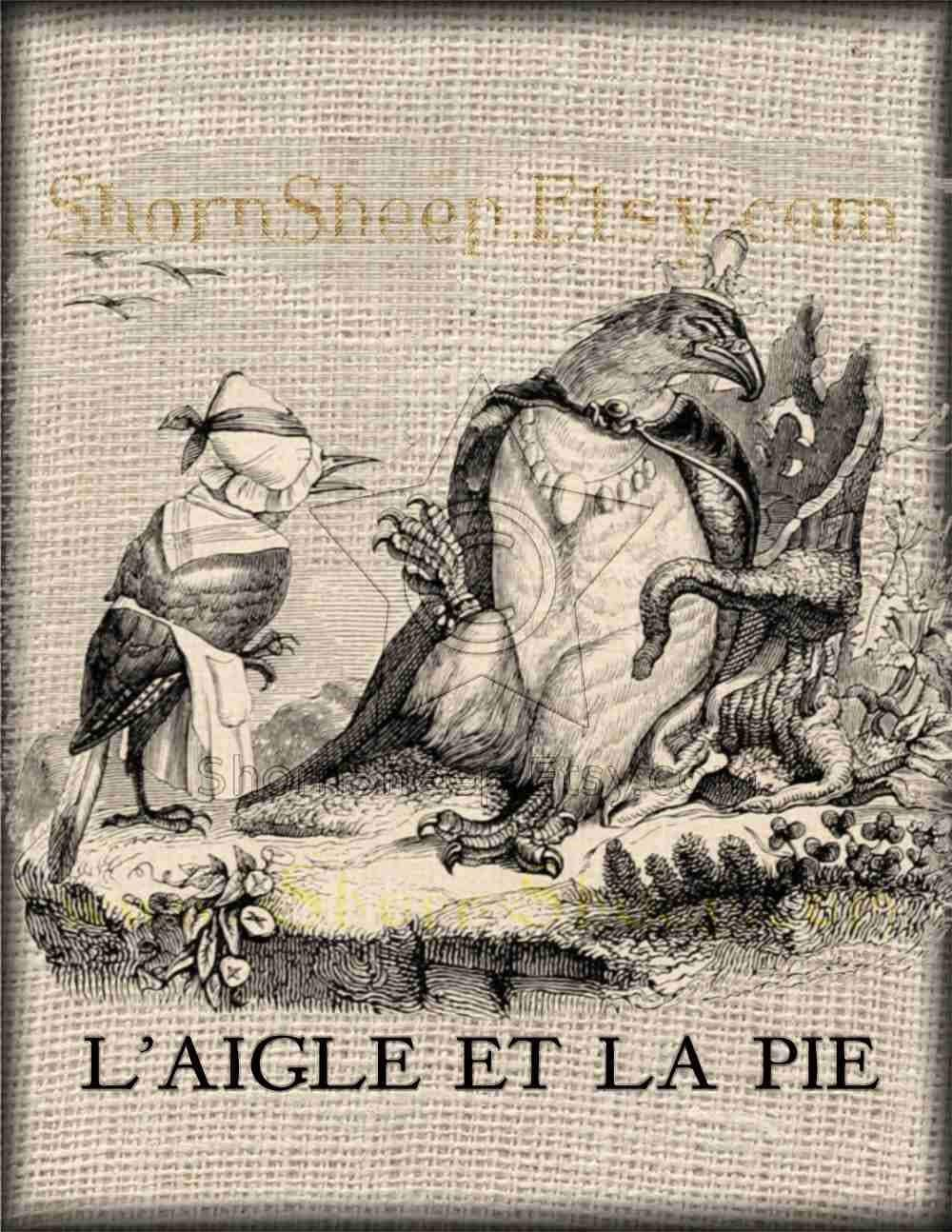
J.J. Grandville was another Frenchmen who liked to poke stabs at those in charge and used many of his drawings as politically commentary of his time.  His illustrations are entertaining and full of wit even to this day.


The Eagle and the Magpie
(Recueil 3, Livre 12, Fable 11)


The eagle, through the air a queen,
And one far different, I believe,
In temper, language, thought, and mien,
The magpie, once a prairie crossed.
The by path where they met was drear,
And Madge gave up herself for lost;
But having dined on ample cheer,
The eagle bade her, "Never fear;
You're welcome to my company;
For if the king of gods can be
Full often in need of recreation,
Who rules the world, right well may I,
Who serve him in that high relation:
Amuse me, then, before you fly."
Our cackler, pleased, at quickest rate
Of this and that began to prate.
Not he of whom old Flaccus writes,
The most impertinent of wights,
Or any babbler, for that matter,
Could more incontinently chatter.
At last she offered to make known
A better spy had never flown
All things, whatever she might see,
In travelling from tree to tree.
But, with her offer little pleased
Nay, gathering wrath at being teased,
For such a purpose, never rove,
Replied the impatient bird of Jove.
"Adieu, my cackling friend, adieu;
My court is not the place for you:
Heaven keep it free from such a bore!"
Madge flapped her wings, and said no more.
It's far less easy than it seems
An entrance to the great to gain.
The honour often has cost extremes
Of mortal pain.
The craft of spies, the tattling art,
And looks more gracious than the heart,
Are odious there;
But still, if one would meet success,
Of different parishes the dress
He, like the pie, must wear.
Jean de La Fontaine
Book 12, Fable 11


These 8x10 full size digital download illustrations are available in both png and jpg formats.  What a marvelous way to add French shabby chic elements to your surroundings.

The Eagle and The Magpie on ArtFire

The Eagle and The MagPie on Etsy

BAT AND WEASEL, Antique French Fables, Image transfer downloads

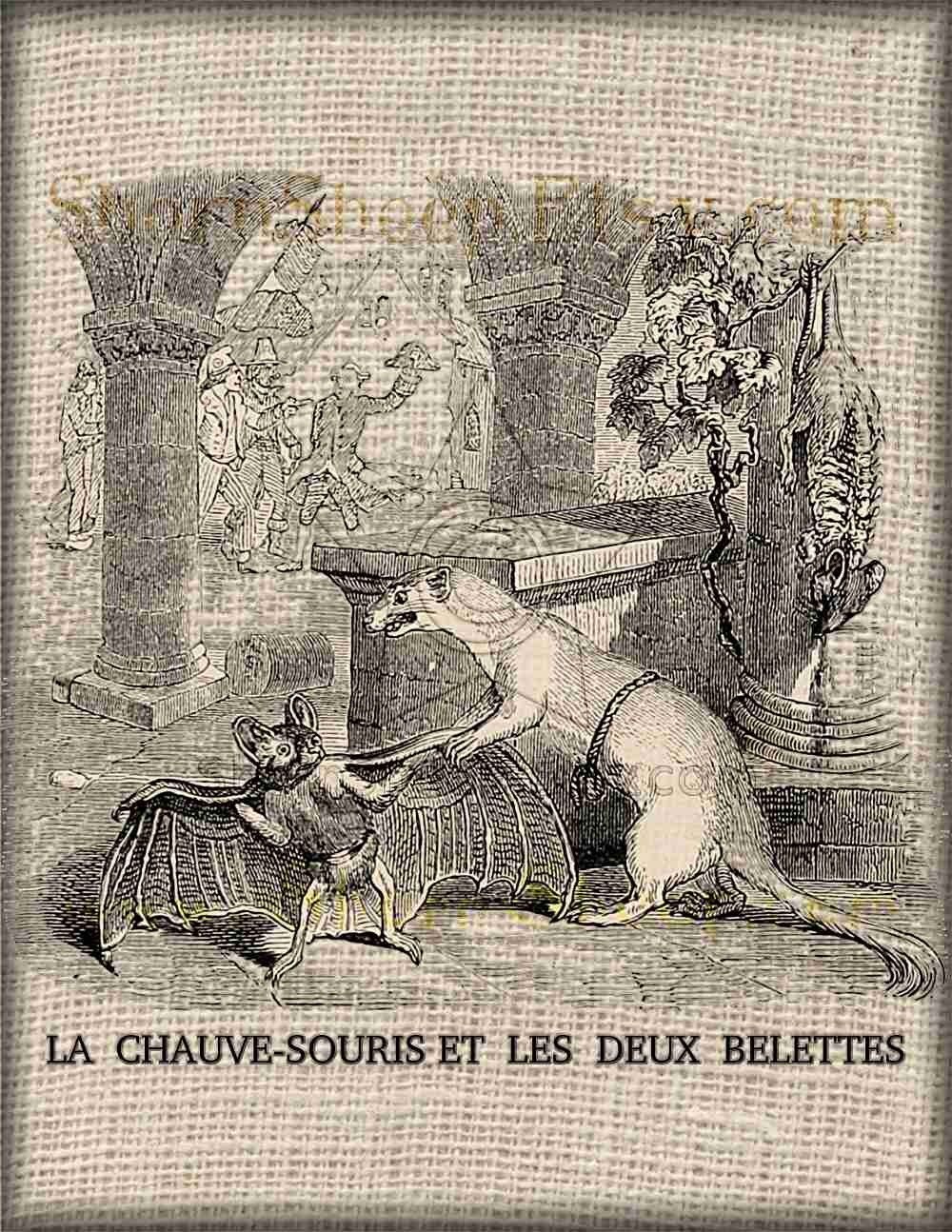
I've been creating some new digital files from Antique French books.  These are all from La Fontaine, illustrated by J.J. Grandville.  The downloads are listed to both Etsy and ArtFire.


The Bat and the Two Weasels
(Recueil 1, Livre 2, Fable 5)

A blundering bat once stuck her head
Into a wakeful weasel's bed;
Whereat the mistress of the house,
A deadly foe of rats and mice,
Was making ready in a trice
To eat the stranger as a mouse.
"What! do you dare," she said, "to creep in
The very bed I sometimes sleep in,
Now, after all the provocation
I have suffered from your thievish nation?
Are you not really a mouse,
That gnawing pest of every house,
Your special aim to do the cheese ill?
Ay, that you are, or I'm no weasel."
"I beg your pardon," said the bat;
"My kind is very far from that.
What! I a mouse! Who told you such a lie?
Why, ma'am, I am a bird;
And, if you doubt my word,
Just see the wings with which I fly.
Long live the mice that cleave the sky!"
These reasons had so fair a show,
The weasel let the creature go.
By some strange fancy led,
The same wise blunderhead,
But two or three days later,
Had chosen for her rest
Another weasel's nest,
This last, of birds a special hater.
New peril brought this step absurd;
Without a moment's thought or puzzle,
Dame weasel oped her peaked muzzle
To eat the intruder as a bird.
"Hold! do not wrong me," cried the bat;
"I'm truly no such thing as that.
Your eyesight strange conclusions gathers.
What makes a bird, I pray? Its feathers.
I'm cousin of the mice and rats.
Great Jupiter confound the cats!"
The bat, by such adroit replying,
Twice saved herself from dying.
And many a human stranger
Thus turns his coat in danger;
And sings, as suits, wherever he goes,
"God save the king!" or "save his foes!"
Jean de La Fontaine
Book 2, Fable 5
La Chauve-souris et les deux Belettes
Livre II - Fable 5

Une chauve-souris donna tête baissée
Dans un nid de belettes ; et sitôt qu'elle y fut,
L'autre, envers les souris de longtemps courroucée,
Pour la dévorer accourut.
«Quoi ! vous osez, dit-elle, à mes yeux vous produire,
Après que votre race a tâché de me nuire!
N'êtes-vous pas souris ? Parlez sans fiction.
Oui, vous l'êtes, ou bien je ne suis pas belette.
- Pardonnez-moi, dit la pauvrette,
Ce n'est pas ma profession.
Moi souris ! Des méchants vous ont dit ces nouvelles.
Grâce à l'auteur de l'univers,
Je suis oiseau : voyez mes ailes.
Vive la gent qui fend les airs ! »
Sa raison plut, et sembla bonne.
Elle fait si bien qu'on lui donne
Liberté de se retirer.
Deux jours après, notre étourdie
Aveuglément se va fourrer
Chez une autre belette, aux oiseaux ennemie.
La voilà derechef en danger de sa vie.
La dame du logis, avec son long museau
S'en allait la croquer en qualité d'oiseau,
Quand elle protesta qu'on lui faisait outrage :
« Moi, pour telle passer ! Vous n'y regardez pas.
Qui fait l'oiseau? C'est le plumage.
Je suis souris : vivent les rats!
Jupiter confonde les chats ! »
Par cette adroite repartie
Elle sauva deux fois sa vie.
Plusieurs se sont trouvés qui, d'écharpe changeants ,
Aux dangers, ainsi qu'elle, ont souvent fait la figue .
Le sage dit, selon les gens,
«Vive le Roi ! vive la Ligue ! »

Files can be downloaded at: